
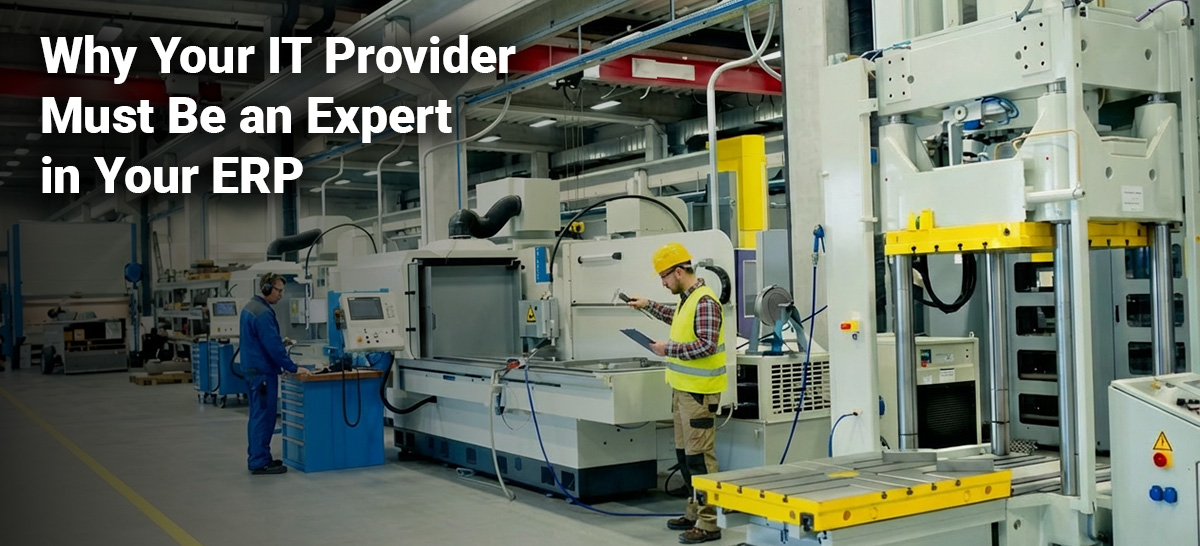
The Hidden Cost of IT Providers Who Don’t Understand Your Manufacturing Business
For small and midsize manufacturers, your ERP system isn’t just software, it’s the operational backbone of your entire business. It manages production schedules, inventory, accounting, quality control, and customer relationships. When your ERP runs smoothly, your business thrives. When it doesn’t, everything grinds to a halt.
Yet a surprising number of manufacturers rely on IT providers who have little to no expertise in their ERP platform. This disconnect creates a dangerous gap in your technology infrastructure—one that costs you time, money, and competitive advantage.
At Upward Technology, we’ve seen firsthand how this misalignment creates unnecessary challenges for growing manufacturers. As the only Preferred IT Partner for Global Shop Solutions, we’ve invested years in mastering this critical platform, and we understand why ERP expertise isn’t optional—it’s essential.
Why ERP Expertise Matters More Than Ever
Modern ERP systems are extraordinarily complex. They integrate with dozens of other systems, rely on precisely configured server architectures, demand specific network configurations, and require cybersecurity protocols tailored to manufacturing environments.
Consider what your ERP touches on a daily basis:
- Production planning and scheduling
- Inventory management and material requirements
- Financial systems and accounting workflows
- Customer relationship management
- Quality control and compliance tracking
- Integration with third-party tools like payroll systems, quoting software, and business intelligence platforms
Everything—from desktop configurations to server architecture to network performance—must be optimized specifically for your ERP environment. A generic IT approach simply can’t deliver the reliability and performance your business demands.
The Three Critical Challenges of Working with a Non-ERP-Expert IT Provider
- Longer Downtime and Finger-Pointing
When something goes wrong, is it an IT issue or an application issue?
Many problems fall into a gray area: a print driver that won’t configure correctly, Remote Desktop latency, intermittent database connection issues, or performance slowdowns during peak hours. These issues require expertise in both the IT infrastructure and the ERP application to diagnose and resolve quickly.
If your IT provider doesn’t understand your ERP, the troubleshooting process becomes a frustrating game of “pass the problem.” Your IT team investigates, can’t find a solution, and escalates to the ERP support team. The ERP team investigates, suspects it’s an IT issue, and sends it back. Meanwhile, your production floor is idle, your team is frustrated, and every hour of downtime costs you money.
An ERP-expert IT provider eliminates the finger-pointing. They can quickly determine the root cause, whether it’s a misconfigured server, a network bottleneck, or an application setting, and resolve it without unnecessary delays.
- Missed Opportunities for Integration and Optimization
No ERP does everything perfectly. Most manufacturers rely on a combination of their core ERP platform and complementary tools to run their business effectively. This might include:
- External payroll or HR systems
- Advanced quoting or estimating software
- Business intelligence tools like Microsoft Power BI
- Automation platforms like Power Automate
- Custom dashboards or reporting solutions
Without deep ERP knowledge, your IT provider can’t guide you toward the best integration strategies. They may recommend solutions that conflict with your ERP’s strengths, create unnecessary complexity, or miss opportunities to leverage native features that would save you time and money.
An ERP-expert IT provider acts as your integration advisor. They know what your ERP does well natively, where third-party tools add value, and how to seamlessly connect your technology ecosystem to maximize your investment.
- No Strategic Technology Roadmap
Perhaps the most significant disadvantage of working with a non-ERP-expert IT provider is the lack of strategic alignment.
Technology decisions shouldn’t be made in silos. Your IT infrastructure, ERP upgrades, cybersecurity initiatives, and business software investments must work together as part of a unified, forward-looking plan.
Consider these questions:
- Is your current server infrastructure ready for the next major ERP update?
- Are you taking advantage of the latest features and integrations in your ERP platform?
- How will upcoming changes in cybersecurity requirements impact your ERP environment?
- What’s the best path to improve reporting and business intelligence without creating data silos?
If your IT provider doesn’t understand your ERP, they can’t answer these questions—and they certainly can’t build a comprehensive technology roadmap that positions your business for long-term success.
An ERP-expert IT provider becomes your strategic technology partner. They proactively identify opportunities, anticipate challenges, and ensure that every technology decision supports your business goals.
The Upward Technology Advantage: IT + ERP Expertise = Maximum Value
At Upward Technology, we don’t just support IT systems—we champion your entire technology ecosystem. As the only Preferred IT Partner for Global Shop Solutions, we bring a level of expertise and partnership that generic IT providers simply can’t match.
Contact us today to learn how to take your technology to the next level.

Leave A Comment